
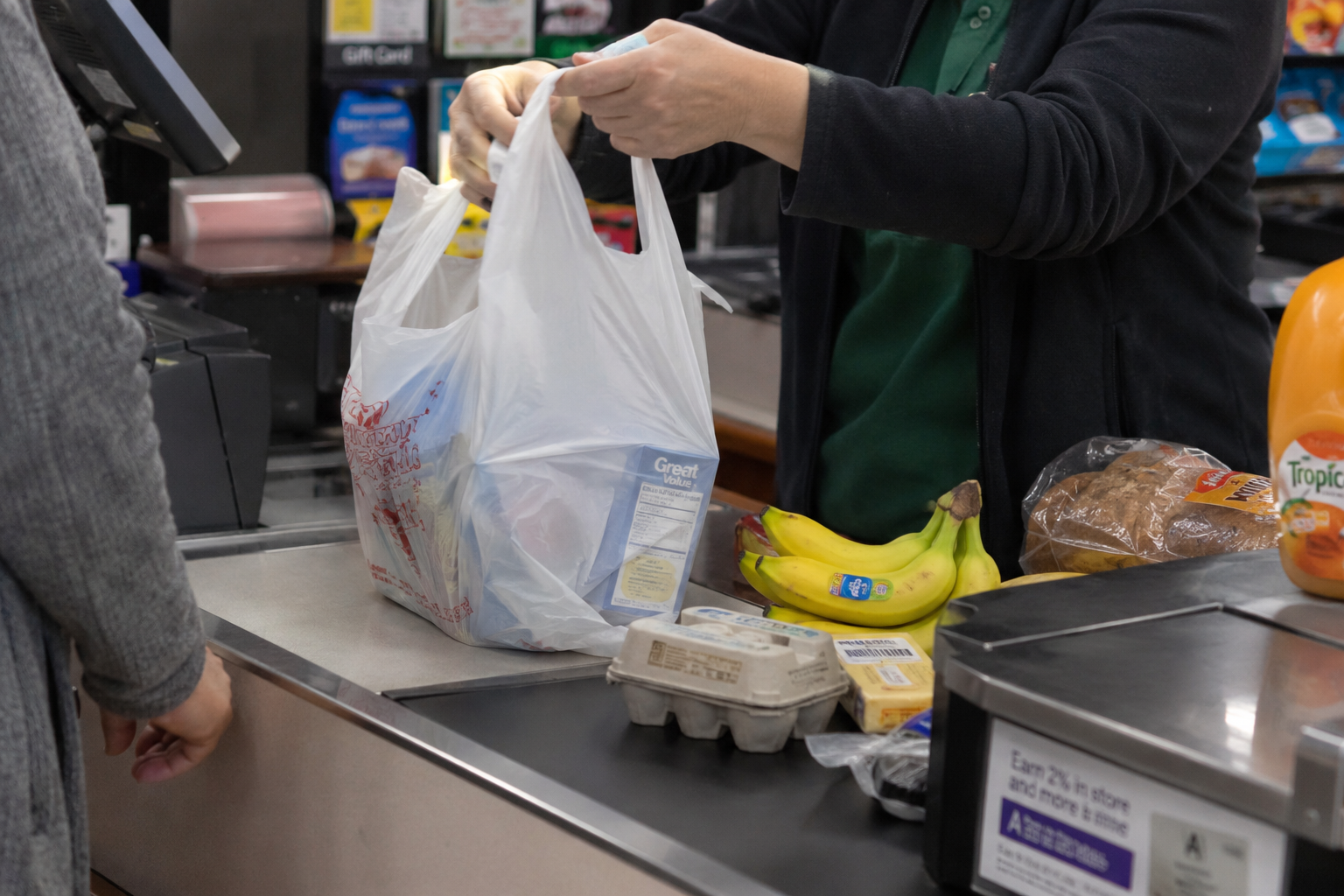
Mankato is considering requiring retailers to charge customers for single-use shopping bags, with a proposed charge of up to 10 cents per bag.
The idea sounds straightforward: make disposable bags more expensive, people use fewer of them, and the environment benefits.
The first two steps are supported by research.
The third is more complicated.
If Mankato is going to impose another mandatory charge on residents and another regulatory requirement on businesses, the City Council should look beyond the simple question of whether bag fees reduce the number of bags handed out at checkout.
The real question should be:
What is the net environmental benefit of this policy in Mankato, after accounting for consumer substitutions, alternative bags, administrative costs, and the actual size of Mankato's bag-litter problem?
Peer-reviewed research provides good reasons to ask those questions before adopting the ordinance.
Yes, Bag Fees Change Consumer Behavior
Any serious discussion should begin by acknowledging what the research clearly shows: charging people for disposable bags can substantially reduce their use.
Economist Tatiana Homonoff examined a five-cent disposable-bag tax and compared it with a five-cent reward for customers who brought reusable bags.
The results were striking.
The five-cent tax reduced disposable-bag use by more than 40 percentage points, while the five-cent reusable-bag bonus produced virtually no change.
Homonoff concluded that the way the incentive is framed matters: people respond much more strongly to having to pay five cents than they do to receiving five cents.
That is strong evidence that a Mankato bag fee could change behavior.
But it also tells us something important about what the policy actually is.
This isn't simply an educational campaign encouraging environmentally responsible choices. The charge works precisely because consumers want to avoid losing money.
Source: Tatiana Homonoff, American Economic Journal: Economic Policy, 2018, 10(4), 177–210, DOI 10.1257/pol.20150261.
There Is Also Evidence Bag Policies Reduce Litter
More recent research provides evidence of an environmental benefit beyond simply counting bags at checkout.
A 2025 study by Anna Papp and Kimberly Oremus published in Science examined 45,067 shoreline cleanups across the United States and compared jurisdictions with and without plastic-bag regulations.
They found that bag policies were associated with a 25% to 47% decrease in plastic bags as a share of items collected during shoreline cleanups, relative to places without such policies.
The researchers concluded that bag regulations have been effective at reducing, although not eliminating, plastic-bag debris along shorelines.
That is significant evidence and should be part of an honest discussion of the issue.
But it doesn't settle the Mankato question.
The study evaluated bag litter at shorelines across many jurisdictions. It does not tell us what percentage of Mankato's litter consists of retail bags, how much the city spends dealing with that litter, or what environmental improvement a 10-cent Mankato charge would produce.
Source: Anna Papp & Kimberly L. Oremus, “Plastic bag bans and fees reduce harmful bag litter on shorelines,” Science, 2025, 388(6753), DOI 10.1126/science.adp9274.
What Happens When People Still Need Plastic Bags?
One of the most important problems with evaluating bag regulations is something economists call leakage.
People don't necessarily use grocery bags only once.
Many reuse them to line small garbage cans, clean up after pets, dispose of diapers, carry lunches, or handle other household waste.
Take those bags away and some consumers simply buy bags for those purposes instead.
Economist Rebecca Taylor studied this effect using California bag regulations and retail purchasing data.
Her 2019 peer-reviewed study in the Journal of Environmental Economics and Management found that eliminating approximately 40 million pounds of plastic carryout bags was accompanied by roughly 12 million additional pounds of purchased trash bags.
Sales increased dramatically in several categories:
Small trash bags: +120%
Medium trash bags: +64%
Tall kitchen bags: +6%
Taylor also estimated that before regulation, approximately 12% to 22% of plastic carryout bags were being reused as trash bags.
In other words, eliminating 40 million pounds of checkout bags did not eliminate 40 million pounds of plastic use.
Roughly 30% of that reduction by weight was offset by increased trash-bag purchases.
That does not mean the regulation produced no environmental benefit. There was still a substantial net reduction in plastic carryout/trash-bag material in Taylor's analysis.
But it demonstrates why simply reporting “we eliminated X number of shopping bags” can exaggerate the environmental benefit.
If people replace free grocery bags with purchased garbage bags, that substitution belongs in the environmental calculation.
Source: Rebecca L.C. Taylor, “Bag leakage: The effect of disposable carryout bag regulations on unregulated bags,” Journal of Environmental Economics and Management, 2019, 93, 254–271, DOI 10.1016/j.jeem.2019.01.001.
Bag Fees Can Also Lose Effectiveness Over Time
There is another reason Mankato should be cautious about assuming that an initial reduction will remain permanent.
Researchers Johane Dikgang, Anthony Leiman, and Martine Visser studied South Africa's plastic-bag levy in a peer-reviewed 2012 paper in Resources, Conservation and Recycling.
They found that charging for bags initially reduced consumption substantially.
But the effect weakened over time.
The authors concluded that the levy had strong short-term effects but declining effectiveness as consumers became accustomed to paying for bags and as the price changed.
That raises an important long-term policy question for Mankato.
Suppose a 10-cent charge initially causes a dramatic reduction in disposable-bag use.
What happens five years later?
If residents eventually treat the dime as another routine cost of shopping, does the city raise it to 15 cents? Twenty-five cents? Fifty cents?
A policy intended to modify behavior should include a way to measure whether that behavioral effect persists.
Source: Johane Dikgang, Anthony Leiman & Martine Visser, “Analysis of the plastic-bag levy in South Africa,” Resources, Conservation and Recycling, 2012, 66, 59–65, DOI 10.1016/j.resconrec.2012.06.009.
“Reusable” Doesn't Automatically Mean Environmentally Free
There is another issue often missing from the debate.
The alternative to a lightweight plastic shopping bag also has an environmental footprint.
Paper bags require raw materials, manufacturing, transportation, and disposal.
Reusable bags require materials and energy to manufacture. Their environmental performance depends on the material, manufacturing process, transportation, disposal method and—most importantly—how often they are reused.
That means the environmentally responsible goal should not simply be:
Replace plastic bags with other bags.
It should be:
Use fewer resources and reuse the bags we already have as many times as practical.
A customer who uses the same durable reusable bag hundreds of times is very different environmentally from someone who repeatedly buys new “reusable” bags because they forgot the ones at home.
Likewise, someone who takes a lightweight grocery bag and later uses it as a garbage liner is not actually using that bag only once.
Taylor's research demonstrates that this secondary use occurs often enough to materially affect the environmental results of bag regulations.
So What Does the Research Actually Support?
Taken together, the research paints a much more nuanced picture than either side of this debate sometimes presents.
Bag fees can substantially reduce disposable-bag use.
Bag regulations can reduce plastic-bag litter.
But some of the apparent reduction in plastic consumption is offset when consumers purchase trash bags they previously didn't need.
The effectiveness of a fee can decline over time.
And alternative bags have environmental costs of their own.
None of that proves that bag fees are universally bad policy.
But neither does evidence showing fewer checkout bags prove that Mankato should impose a 10-cent fee.
That requires local evidence.
Where Is the Mankato Cost-Benefit Analysis?
Before approving the ordinance, the City Council should provide residents with answers to some basic questions.
How many single-use retail bags are currently distributed in Mankato each year?
What percentage of Mankato litter consists of these bags?
How much does Mankato currently spend cleaning them up?
How many tons of plastic does the city expect the ordinance to eliminate?
How much of that reduction is expected to be offset by increased purchases of trash bags?
What increase in paper-bag consumption is expected?
What types of reusable bags does the city expect residents to adopt?
What is the estimated net reduction in greenhouse-gas emissions?
What is the estimated reduction in litter?
How much will administration and enforcement cost?
How much money will consumers pay in bag charges annually?
And, perhaps most importantly:
What measurable environmental target would determine whether the ordinance succeeded?
If the City Council cannot answer these questions, then how can it determine whether 10 cents is the correct charge—or whether a mandatory charge is warranted at all?
A Dime Doesn't Affect Everyone Equally
Supporters may reasonably say that ten cents is a trivial amount.
For many residents, it is.
But that misses the point.
The entire policy depends upon ten cents not being trivial.
If consumers don't care about the charge, it won't change behavior.
Homonoff's research demonstrates exactly that: small fees can produce large behavioral changes because people react strongly to paying a charge.
That creates an unavoidable contradiction in arguing simultaneously that the charge is large enough to change people's behavior but too small to matter financially.
For households with comfortable incomes, remembering reusable bags may simply become another routine.
For residents watching every dollar at the grocery store, forgetting them means another expense at the checkout counter.
Public policy should consider that burden even when the dollar amount appears small.
And Businesses Get Another Mandate
Retailers would also become the mechanism through which the city implements the policy.
Businesses may need to modify checkout procedures, train employees, explain the charge to customers, determine which bags are covered or exempt, account for the charges, and comply with whatever administrative requirements accompany the final ordinance.
Those burdens may be modest for a large retailer.
They are not necessarily equally modest for every small business.
Before imposing another requirement on Mankato businesses, the city should demonstrate that the benefit justifies the burden.
There Is a Better Starting Point
Mankato doesn't have to choose between doing nothing and imposing a mandatory charge.
The city could encourage reusable bags voluntarily.
Retailers could offer incentives for customers who bring bags.
The city could distribute reusable bags to residents who want them.
Public education could encourage people to reuse whatever bags they already own rather than continually acquiring new ones.
And most importantly, Mankato could conduct a local litter and waste analysis to determine whether disposable retail bags are actually a significant environmental problem here.
If the data demonstrate that they are, residents can have an informed discussion about the appropriate response.
Environmental Policy Should Be Measured by Environmental Results
The research doesn't support pretending that bag fees accomplish nothing.
They clearly change consumer behavior, and recent evidence indicates they can reduce bag litter.
But good policy requires another question:
How much benefit will this particular ordinance produce in Mankato, and at what cost?
Reducing the number of bags handed out at checkout is an easily measured statistic.
Reducing Mankato's overall environmental footprint is the actual goal.
Those aren't necessarily the same thing.
Before mandating another charge on consumers and another requirement on businesses, the Mankato City Council should demonstrate the size of the local problem, estimate the net environmental benefit, account for unintended consequences, and establish measurable goals.
If the evidence shows that a 10-cent fee produces substantial environmental benefits for Mankato that cannot reasonably be achieved through less burdensome measures, make that case to the public.
But if the justification begins and ends with “people will use fewer bags,” that isn't enough.
Good environmental policy should be based on measurable environmental outcomes—not simply on the number of bags leaving the checkout counter.